2025 was a landmark year for SEO, marked by seismic shifts in how search engines deliver results and how websites strive for visibility.
Google’s rapid integration of generative AI into search – from AI-generated answer overviews to a new “AI Mode” – dramatically changed user behavior and the rules of optimization. Meanwhile, Google rolled out several major algorithm updates (and countless unconfirmed tweaks) that kept SEOs on their toes. In this mega-review, we’ll recap everything that changed in SEO in 2025 – all the Google core updates and spam updates, the rise of AI in search, critical shifts in strategies for SaaS, e-commerce, and local businesses – backed by key stats and metrics.
Finally, we’ll look ahead with predictions for SEO in 2026, outlining what site owners and marketers should focus on to stay visible and drive traffic and revenue in an AI-driven search landscape. Let’s dive in.
SEO in 2025: By the Numbers
To set the stage, here are some key SEO statistics from 2025 that highlight the state of search and user behavior this year:
Google’s dominance: Google handled about 90%+ of global search queries as the leading search engine. It processed 16+ billion searches per day, and over 68% of all online experiences start with a search engine. Mobile remained crucial, accounting for ~63-77% of search traffic, depending on the industry.
Organic vs paid: Roughly 65-73% of search clicks went to organic (non-ad) results, underscoring the importance of SEO for visibility. The first page of Google captures 99% of clicks, making top rankings more critical than ever.
AI in search results: Google’s new AI Overviews (generative answers in search) reached mainstream adoption. By late 2025, over 20% of Google search queries triggered an AI-generated overview, and in some categories up to 60% of searches showed these AI answers. Google’s AI Mode – a conversational search interface – also rolled out broadly in 2025, transforming many searches into chat-style sessions. We’ll explore these in depth shortly.
Zero-click searches: The prevalence of direct answers and AI summaries led to a record high in “zero-click” searches (where the user doesn’t click through to any website). By August 2025, nearly 69% of all Google searches ended without a click, as users often found what they needed within Google’s interface. This trend raised concerns for content publishers who rely on search traffic.
AI-generated content explosion: The content landscape was flooded with AI-created material. An estimated 74% of all new online content in 2025 was produced with the help of generative AI. In SEO surveys, 86%+ of marketers reported integrating AI tools into their content workflow. While this boosted output, it also forced Google to refine quality signals to distinguish truly helpful, human-guided content from mass-produced AI text.
Local search and e-commerce: 72% of consumers used Google to find local businesses in 2025, reaffirming the importance of local SEO. And global e-commerce continued its surge – worldwide online sales topped $6 trillion, with nearly 60% of U.S. shoppers using AI tools like ChatGPT or Google’s Gemini AI to assist purchase decisions. In fact, 59% of shoppers use Google specifically to research products they intend to buy.
These stats illustrate the high-level story: Google Search remained the primary gateway to the web, but how people search and what they see changed profoundly. Next, let’s review the Google algorithm updates of 2025 – the confirmed changes that Google rolled out – and their impact on site rankings.
Major Google Algorithm Updates in 2025
Google officially confirmed fewer algorithm updates in 2025 than in previous years, but that doesn’t mean the search results were any calmer.
In total, Google acknowledged four broad updates: three were core algorithm updates, and one was a spam-fighting update. (By comparison, 2024 saw seven confirmed updates.)
Google hinted that they are now announcing only the most significant changes, even as many smaller tweaks occur under the radar. The year was in fact highly volatile in the SERPs, with numerous unconfirmed “tremors” between official updates.
Timeline of 2025 Google Updates: Figure 1 below summarizes the timeline of confirmed Google Search updates in 2025.
There were core updates in March, June, and December, and a lengthy spam update that spanned late August into September. Each brought waves of ranking changes across industries.

Timeline of Google’s confirmed search ranking updates in 2025 – including three broad Core Updates (March, June, December) and one Spam Update (Aug-Sep). Source: Search Engine Land.
Let’s briefly recap each of these updates and what changed:
March 2025 Core Update: Google kicked off the year with a broad core algorithm update starting March 13, 2025, which officially took about 14 days to fully roll out (completed by March 27).
As with prior core updates, this was a “regular update designed to better surface relevant, satisfying content for searchers from all types of sites,” according to Google. In practice, SEOs reported typical volatility – some sites saw significant drops or gains in rankings.
Notably, Google hinted that throughout 2025 it would be increasing the visibility of content from individual creators (likely an ongoing E-E-A-T effort) in addition to these core changes.
The March update’s impact was widespread but not unusual: it targeted quality and relevance. Data after the rollout suggested its volatility was in line with previous core updates.Unconfirmed April “Aftershocks”: Although not officially labeled an update, many site owners observed that early April 2025 was turbulent in search results.
These “aftershocks” were likely the tail-end effects of the March core update or additional tweaks. Several ranking “spikes” were noted around April 2, April 9, and April 15-16. During these periods, thin or AI-generated content pages tended to drop sharply, while sites with strong E-E-A-T (Experience, Expertise, Authority, Trust) and solid content structure either held steady or gained.
This pattern suggested Google’s systems were increasingly penalizing generic, low-value content (often AI-produced) and rewarding content demonstrating real expertise and originality. In forums, some webmasters reported losing 50–70% of their traffic overnight in April, even without a new “named” update – a reminder that Google’s core update adjustments can continue to roll out and affect sites weeks later.June 2025 Core Update: The second broad core update of the year launched on June 30, 2025 and officially ran until July 17 (about 16 days). Google again described it as a “regular update” with the same goal of improving search results quality.
SEO trackers recorded significant ranking flux in early July; interestingly, some sites that had been previously hit by Google’s 2023 “helpful content” update or earlier core updates reported partial recoveries after the June 2025 update. This hinted that Google possibly dialed back certain aggressiveness or refined its criteria, allowing some once-penalized sites to regain visibility.
Still, the June update wasn’t smooth for everyone – a burst of “heated volatility” was observed around July 11–14 as the rollout neared completion. In short, June’s core update reaffirmed the need for genuinely helpful content: sites that demonstrated improvements in content depth and user satisfaction tended to fare better, whereas those relying on stale tactics saw turbulence.August 2025 Spam Update: Late summer brought a targeted spam algorithm update, starting on August 26, 2025 and running a lengthy 27 days until September 22.
Google simply called this a “broad spam update”, impacting all languages and regions. No specific aspect (like links or reviews) was singled out; it was an across-the-board improvement to Google’s spam detection systems (including its AI-based SpamBrain). This update hit fast – many sites that were vulnerable to spam signals (e.g. having thin, scraped, or malicious content) saw drops within the first 24 hours.
There was a second spike around September 9 as the update intensified. Sites that had been previously caught by past spam updates sometimes recovered if they had cleaned up their act, while new offenders got dinged. For most legitimate websites, Google said a spam update “should not impact” them – but those that did see traffic vanish needed to review Google’s spam policies and improve site quality.
The unusually long rollout (nearly four weeks) indicates Google made significant behind-the-scenes changes to how it fights spam. In the SEO community, some small business and local sites felt this update “hit small businesses hard”, especially ones that might have had older SEO practices or sketchy backlinks.
Overall, the August Spam Update reinforced Google’s increasingly strict stance on low-quality tactics: if your site got swept up, it was a wake-up call to remove spammy content or links and focus on authenticity.December 2025 Core Update: Google saved one of the biggest for last – a broad core update starting December 11, 2025, which took a full 18 days to roll out, ending by December 29.
This was the third core update of the year, coming about five months after the June update. Industry observers noted that an 18-day rollout is slightly longer than the typical 14-day core update, and indeed this update arrived in waves. According to reports, major ranking volatility was seen around December 13 (two days in) and again around December 20.
Google characterized the December update the same as others – “a regular update designed to better surface relevant, satisfying content” – but its timing was rough for many websites. Publishers and e-commerce sites voiced concern because the hit came during the critical holiday period.
Some publishers reported traffic plummeting 70-85% within 48 hours of the update’s start, with Google Discover traffic in particular disappearing for many news sites. Sites that had ranked in top positions for years found themselves knocked down to page 2 or beyond overnight.
In SEO forums, the December core update was described as unusually harsh – long-standing high-authority pages dropped dramatically, suggesting Google made substantial tweaks to content evaluation. (Google Discover, which relies on similar signals as search, also suffered, implying core ranking signals were significantly recalibrated.)
By the time the rollout completed just after Christmas, the dust was still settling. In short, the December 2025 update was a major algorithmic refresh, forcing webmasters to scrutinize their content quality, authority, and perhaps technical factors as they head into the new year.
Key Takeaway: Google’s 2025 updates rewarded authenticity and user-first content more than ever.
Across the core updates and spam update, common threads emerged: sites with thin, AI-written or misleading content lost ground, while those demonstrating real expertise, trustworthiness, and good site experience often weathered the storms or even gained.
Google is also communicating less about updates (only flagging big ones), so SEOs had to pay attention to ranking flux and user metrics continually.
And as we’ll see next, algorithm updates weren’t the only thing shaking up SEO – the insertion of AI into Google’s search results was the other game-changer of 2025.
The Rise of AI in Search: SGE and “AI Mode” Redefine SEO
If one trend defined SEO in 2025, it was AI – not as a buzzword, but as a tangible part of search results. Google massively expanded its use of Generative AI in how it answers queries, following on the experimental steps it took in late 2023.
By the end of 2025, AI-driven features were front and center on the SERP: many users now see a synthesized answer (AI Overview) for informational queries, and can even engage in follow-up questions with Google’s search AI.
This has profound implications for SEO, as it changes how users interact with search and what it takes to earn visibility. Let’s break down the major AI-driven shifts:
AI Overviews (SGE) go mainstream: In 2023, Google introduced the Search Generative Experience (SGE) in Labs; in 2025, it became broadly available as AI Overviews for users.
By mid-year, Google had rolled out AI-generated answer summaries to all U.S. users (mobile and desktop), and later expanded to many international markets. According to industry data, these AI Overviews were appearing in roughly 13-20% of all searches by summer 2025, largely for informational queries.
In real terms, that’s enormous: Google Search was handling billions of AI-aided queries. Google even cited that AI Overviews reached around 1.5 billion users per month globally by mid-2025.
The AI Overview appears at the top of search results as a rich, conversational answer (often with cited sources), meaning users can get their answer without clicking a result. This accelerated the “zero-click” phenomenon – as noted, nearly 69% of searches ended on Google itself by late 2025, with the AI box giving the needed info.
Publishers whose content is used for these answers may get a citation (link), but often users don’t feel the need to click through. SEO thus started to encompass not just ranking under the 10 blue links, but being one of the sources the AI chooses to quote. We’ll discuss how to optimize for that in a moment.Google “AI Mode” – search becomes a conversation: A notable debut in 2025 was Google’s AI Mode, essentially a new conversational search tab. Announced at Google I/O in May and rolled out by June, AI Mode allows users to enter a more chatbot-like interface within Google Search.
When AI Mode is activated (for example, after certain longer or exploratory queries), the UI shifts: instead of the standard results page, you get an interactive Q&A interface where Google’s AI answers in a dialog format, and you can ask follow-up questions contextually.
Figure 2 shows an example of Google’s AI Mode interface. This mode uses Google’s advanced Gemini AI models to perform what Google calls “multi-search query fan-out” – basically, it runs multiple searches in parallel on subtopics and synthesizes the results for you.
AI Mode is especially geared toward complex queries where comparison or deeper reasoning is helpful. By late 2025, Google had upgraded the AI models powering these features multiple times (Gemini 2, then Gemini 3 “Flash” and “Pro” versions) to improve the quality of AI answers. The reach of AI Mode also widened: initially U.S.-only, it expanded to more countries as the year progressed.
This development signaled that Google is moving search from a “type query, get links” paradigm to an interactive, AI-assisted dialogue.
For SEOs, it means content might be surfaced to users via an AI conversation without a traditional click – for instance, the AI might pull a step-by-step from your blog to answer a follow-up question.

Figure 2 – Google’s new AI Mode in action – a conversational search interface that provides AI-generated answers with follow-up questions. This mode, rolled out in 2025, transforms search into a chat-like experience (example above: AI Mode answering a question while the user is signed-out). In AI Mode, Google uses multiple searches and its Gemini AI to compile a comprehensive answer.
Search ads and analytics adapt: One immediate question was how Google would integrate ads into these AI experiences – after all, Google’s revenue depends on ads.
In 2025 we saw the answer: ads began appearing within AI Overviews and even in AI Mode chats. For example, Google experimented with sponsored product listings embedded in a generative answer for shopping queries.
This means businesses not only compete for organic visibility in AI answers, but also for paid placements inside those answers. At the same time, measuring SEO performance became trickier. Google’s Search Console started reporting on AI impressions and clicks, but without granular filters, making it hard to separate “traditional” search from AI search in the data.
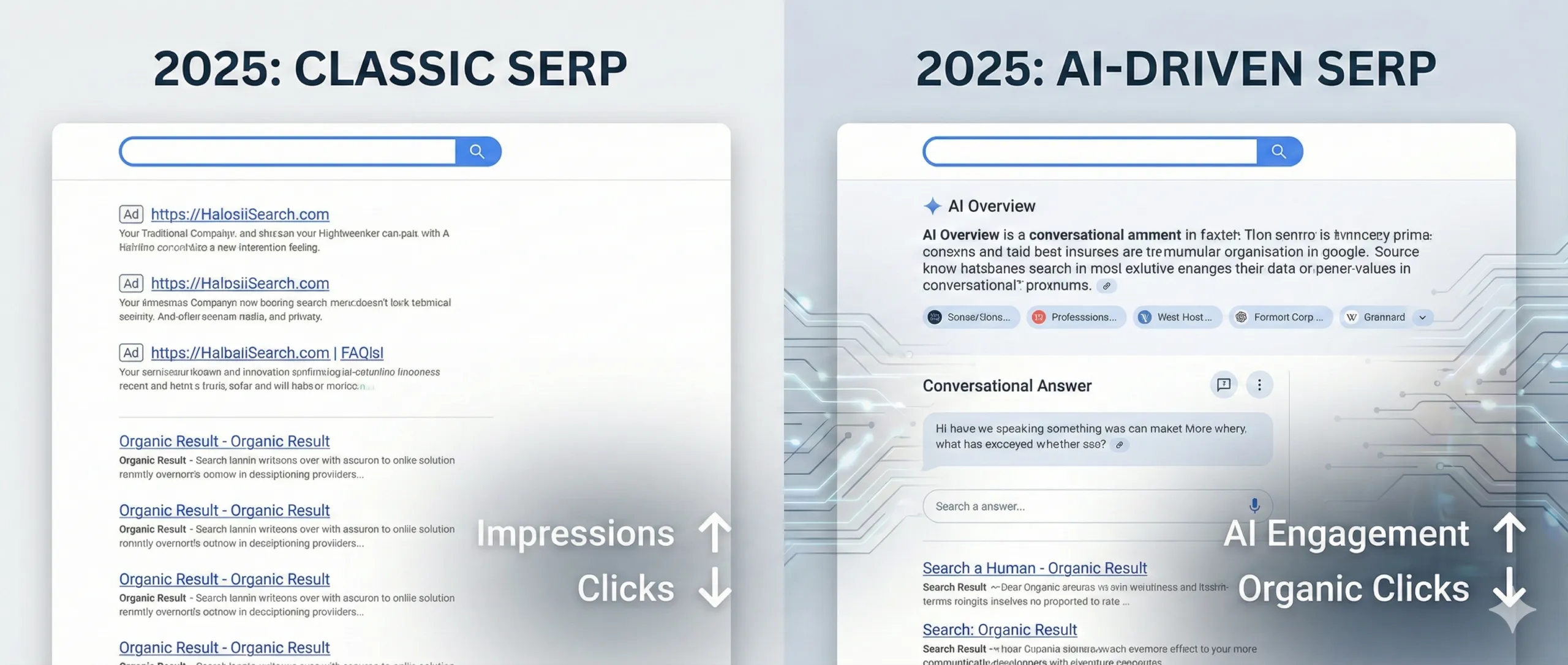
Many SEO teams observed a puzzling trend: impressions (visibility) would skyrocket thanks to AI answers showing their content, but clicks to the site would not follow the same trend (because users got the info from the AI summary).
This “decoupling” of visibility and traffic became a core theme of 2025 SEO – one that forced marketers to rethink metrics and attribution.Content selection and sources: Not every site gets featured in AI answers – Google’s systems choose what they deem high-quality, authoritative sources to cite. SEOs noticed that roughly 97% of URLs cited in AI Overviews were already ranking in the top 10 organically.
In short, strong traditional SEO is a prerequisite to even be considered by the AI. But beyond that, different AI systems have different source preferences. Google’s might lean toward trusted sites or those with clear structured info; Bing’s chat might prefer Wikipedia or its own indexed results; other tools might favor community Q&A, etc.
This means optimizing content for AI discovery isn’t one-size-fits-all. However, a consistent finding was that content that is easy for AI to parse – clear headings, concise answers, schema markup – had a better chance of being used. Content that is overly fluffy or too generic (easily summarized) could be answered by the AI without a need to cite a source.
In fact, some SEO experts suggested making your content “resistant to summarization” – meaning add unique insights, data, or a distinctive voice that an AI can’t easily replace with a generic summary.
This aligns with Google’s advice to provide “experience” in content (the extra E in E-E-A-T).User behavior shifts: The net effect of these AI features is that search behavior is evolving. By late 2025, Google indicated that about one-third of searches involved an AI element or “AI agent” in the journey.
Many users now treat Google as a destination for answers (and even shopping info) rather than a stepping stone to websites. Voice search and visual search also blended in – AI Mode supports voice queries and even image inputs. We also saw the rise of multimodal queries (e.g. uploading a photo to search within an AI chat).
Alternative search platforms gained some traction as well: for example, Gen Z users increasingly search on TikTok or Pinterest for certain topics (by May 2025, 39% of consumers used Pinterest as a search engine for discovery). All this means the classic “Google search -> click website” path is no longer the only game in town.
SEO practitioners began referring to this expanded mindset as “generative engine optimization (GEO)”, focusing on optimizing content to be discovered and cited by AI platforms.
Some WordPress SEO plugins even introduced experimental features like LLM-friendly sitemaps (LLMs.txt) to feed content to AI models, though Google has not endorsed any such method (and currently doesn’t use LLMs.txt).
Bottom line: AI integration into search has created both opportunities and challenges for SEO. On one hand, if your content is authoritative and well-structured, you might gain tremendous exposure by being featured in AI answers (even if you don’t get the click, the brand visibility can be valuable).
On the other hand, if your content is easily replicated or if you rely on click-through traffic for revenue (think ad-supported sites), the rise of zero-click answers is a direct threat to your model.
2025 forced SEOs to broaden their thinking: it’s no longer just about blue links and rankings, but about overall visibility in an AI-driven ecosystem.
This meant doubling down on content quality and clarity – which brings us to the next section: how the content landscape changed in response.
Content Quality, E-E-A-T & Core Web Vitals in 2025
With the twin forces of algorithm updates targeting low-quality content and AI systems choosing which content to show, quality and user experience became paramount in 2025.
Google has long preached “create helpful, people-first content,” but this year really separated the wheat from the chaff. A few key developments on this front:
1. Helpful content system and E-E-A-T: Google’s Helpful Content System, introduced in late 2022 and integrated into core rankings by 2024, continued to weed out content that is solely written “for SEO” rather than to help users.
In 2025, although there was no separately announced “helpful content update,” the effects were felt through core updates and unconfirmed tweaks. Sites that published masses of generic, AI-generated articles (with little originality or expertise) often found themselves demoted.
As noted earlier, in the April mini-flux, sites with “thin content…with generic AI text” were hit hardest. Google’s quality raters and algorithms got better at detecting “fake authority” and fluff – for instance, the Search Quality Rater Guidelines were updated to call out deceptive expertise claims or manufactured credibility signals.
On the flip side, demonstrating real E-E-A-T (Experience, Expertise, Authoritativeness, Trustworthiness) became even more crucial. This might mean featuring credentialed authors, citing real experiences or data, and having a solid brand reputation in your niche. Google’s systems and even its AI answers tend to favor sources that have established trust.
A practical example: in a legal query, an AI overview is more likely to pull from an authoritative legal site or a law firm blog that showcases case experience, rather than a content farm. In local SEO, Google shifted towards community engagement and authenticity as new trust signals – e.g. being mentioned in local news or having real customer reviews (as we’ll cover in the local section) – over old tricks like keyword stuffing in business names.
All these changes underscore that SEO content in 2025 had to be truly valuable. As one industry expert put it, “SEO isn’t about tricking algorithms; it’s about making your expertise unmistakable.
Write for humans, but structure for machines, and build authority that holds up even when clicks don’t follow.” This mantra will ring even truer into 2026.
2. The AI content deluge and Google’s response: We saw earlier that roughly 74% of new content was AI-assisted in 2025 – an astounding figure that reflects how accessible tools like OpenAI’s ChatGPT, Google’s Bard (Gemini), and others have become for content creation.
This brought benefits (faster content production) but also risks: a lot of duplicative, low-effort content hit the web. Google’s stance evolved to effectively neutral on AI-generated content, as long as it’s helpful and meets their guidelines.
They care about the what (quality), not the how (AI or human). So how did they handle the deluge of AI content? Largely through the mechanisms above (helpful content system, core updates, etc.) to demote unhelpful pages.
For instance, one SEO study noted that pages with formulaic, overly polished AI writing styles started losing credibility – they just didn’t perform as well as those with a bit more human touch or unique insight.
We also saw publishers getting smarter about using AI: rather than publishing raw AI outputs, many began using AI for outlines or first drafts, then adding human expertise.
This hybrid approach is likely to succeed, whereas pure AI spam is increasingly filtered.
Google even improved its SpamBrain AI to catch AI-generated spam pages (some reports suggest the March 2025 core update reduced “unhelpful” content by 40% by targeting AI gibberish and other low-quality pages).
Overall, AI is now part of the content production toolkit for SEO, but it’s not a shortcut to success. If everyone can generate 100 articles a week, the winners will be those who add that extra mile of quality – original research, personal experience, better examples, clearer structure, etc., which AI alone can’t replicate well.
3. Core Web Vitals and user experience: Page experience remained a priority in 2025, albeit with a slightly reduced emphasis from Google’s communications.
Google removed the explicit “page experience” ranking factor label in Search Console, but site speed and usability are still critical – if only because they impact user behavior directly. A telling stat: 40% of users will abandon a website if it takes more than 3 seconds to load.
That kind of user impatience is timeless. In 2025, Google did finalize a big change in Core Web Vitals: the new Interaction to Next Paint (INP) metric officially replaced First Input Delay (FID) as of March 2024, becoming an official part of the Core Web Vitals trio (alongside Largest Contentful Paint and Cumulative Layout Shift).
INP measures how responsive a page is when users try to interact (click, scroll, etc.), and Google considers sites with good INP (under 200ms for most interactions) as providing a better UX. Many websites spent 2025 optimizing for INP – improving their JavaScript performance and reducing main-thread blocking – to meet Google’s “good” threshold.
While Google in August 2023 had downplayed the direct ranking boost of Core Web Vitals, it’s understood that fast, smooth sites perform better in retaining users (and likely indirectly help SEO by reducing bounce rates and increasing engagement).
There was also an interesting update in June 2025 regarding explicit content: Google announced that if you have videos on your page and you block Google from fetching those video files, they might assume you’re hiding something (like explicit content) and could demote those pages.
This was essentially a policy to combat CSAM and egregious content, but it served as a reminder: don’t prevent Google from accessing your important page elements, and ensure that trust and safety signals are in order. For most businesses, the takeaway on “page vitals” in 2025 is to continue polishing your site’s technical SEO – mobile-friendliness, speed, safe browsing, etc. – not because of a big algorithm boost, but because it’s foundational.
Many companies did see improvements by doing so: for instance, it’s reported that 91% of SEO professionals used technical improvements and saw positive results in site performance.
In summary, 2025’s SEO winners combined great content with great UX. High-quality, trustworthy content (often enriched or at least reviewed by humans) was non-negotiable in the face of algorithm scrutiny and AI parsing.
At the same time, ensuring your site is fast, stable, and accessible on all devices helped keep users engaged – which is more important than ever when one click might be all you get (or when getting the click is hard to begin with!).
Now, let’s zero in on how these broad changes played out in specific industries and verticals. SEO is not one-size-fits-all; a SaaS software company, an e-commerce retailer, and a local brick-and-mortar each faced unique challenges in 2025. Below, we examine the key SEO shifts for SaaS, e-commerce, and local businesses this year.
SaaS & B2B SEO in 2025: Content Marketing Meets AI
For SaaS companies and B2B marketers, organic search remained a cornerstone of demand generation in 2025 – but the tactics evolved.
This sector traditionally relies on content marketing (blog posts, whitepapers, comparison pages, etc.) to attract and educate prospects. In 2025, that trend continued, with even greater emphasis on thought leadership and topical authority, while adapting to AI-driven search and intense competition.
Some highlights and shifts in SaaS SEO:
Search is integral to the B2B buyer journey: 66% of B2B SaaS buyers use search engines to research solutions before purchasing.
This stat, from a 2025 survey, underscores that being visible on Google (and now in AI answers) at various stages of the funnel is critical. Whether a user is searching “best [category] software” or troubleshooting a problem (“how to improve X process”), SaaS brands want to appear with helpful content.
In fact, organic search accounts for an estimated 50+% of the traffic and 40+% of revenue in many B2B industries. So, SaaS marketers in 2025 doubled down on SEO-driven content.Content volume and quality: Many SaaS companies scaled up content production – often with AI assistance – but found that more content alone isn’t a guarantee of SEO success.
A Forbes insight noted that to break through, SaaS firms should aim to publish at least ~20 high-quality content pieces per month and build robust clusters on key topics.
However, the content needed to be truly valuable: Google’s updates rewarded SaaS sites that offered in-depth guides, original research, case studies, and expert insights rather than superficial posts. Notably, sites that demonstrated real expertise or unique data about their niche tended to earn coveted spots in AI overviews and featured snippets.
For example, a project management SaaS that published a detailed study with statistics on remote work productivity might get cited by Google’s AI in an answer about remote work trends. E-E-A-T is crucial for B2B because buyers look for credible, trustworthy information.
Companies highlighted their subject-matter experts, added author bios, and got industry influencers involved to boost credibility of content.AI content and human oversight: SaaS marketers eagerly adopted AI writing tools to scale content – surveys showed 91% of SaaS businesses saw improvements in marketing performance through SEO in 2024 (likely aided by efficiency from AI).
And 98% of SaaS companies now have an active blog (almost all leveraging content for SEO). But many learned that human oversight is essential. Early in the year, some SaaS blogs that went overboard with unedited AI content saw ranking drops, especially if the content was generic or duplicative.
By late 2025, the best SaaS SEO teams were using AI as a assistant – e.g., to generate outlines, drafts, or repurpose content – but then layering on human expertise, updating articles with real use cases, and ensuring accuracy.
The helpful content system and core updates likely filtered out the worst of the AI-generated fluff in this sector as well.
Put simply: AI helped SaaS content teams do more, but those who hit “publish” without review paid the price.Link building and authority: In B2B, backlinks and PR still played a big role in SEO success. Many SaaS companies invested in digital PR campaigns, thought leadership articles, and partnerships to earn quality backlinks.
Stats show that the top-ranking SaaS websites have 3.8 times more backlinks than lower-ranking ones. Additionally, SaaS sites with active content (e.g., regularly updated blogs) attracted 97% more backlinks than those without fresh content. This creates a virtuous cycle: content drives links, which drive authority, which improves rankings.
However, link strategies had to be smart in 2025 – any hint of spam (like participating in link schemes or unnatural guest posting) could backfire, especially with Google’s spam update in effect.
SaaS marketers focused on earning links through valuable content (infographics, original research reports, etc.) and leveraging their relationships (e.g., getting links from partners, testimonials, SaaS directories).Optimizing for AI and new search formats: Savvy SaaS SEOs also started optimizing for AI-driven results. This meant ensuring their content answers common questions clearly (to get picked for AI Overviews), using structured data like FAQs, HowTo, and product schema where applicable, and even providing concise definitions or summaries that an AI might grab.
Many SaaS sites added Q&A sections on their pages anticipating conversational queries. For instance, a CRM software site might have a Q&A addressing, “What’s the best CRM for small businesses with remote teams?” – a query an AI chat might handle.
Also, video and visual content became more prominent, as 91% of SaaS businesses used video as part of marketing (which can rank in search or be utilized by Google’s algorithms in understanding content).
The key is that SaaS buyers often search for comparisons and tutorials; videos and charts can enrich a page’s content and perhaps even be referenced by Google (e.g., in video featured snippets).
In essence, SaaS SEO in 2025 was about marrying content quality with quantity – leveraging AI to produce more useful content, but maintaining a human touch and authority.
Companies that provided genuine value (not just keyword-stuffed blog posts) saw big gains in organic traffic and leads. A notable example: Monday.com, a popular B2B SaaS, grew its monthly organic traffic from ~677k to 1.2 million by executing a strong SEO content strategy over time.
That kind of growth story shows SEO is far from dead for SaaS – it’s evolving. As we look to 2026, SaaS firms will need to continue focusing on expertise-driven content and find ways to stand out as AI answers become more common (we’ll revisit this in the predictions section).
E-commerce SEO in 2025: Adapting to AI-Assisted Shopping
For e-commerce and retail websites, 2025 was a year of both opportunities and challenges in search. Online shopping hit new heights, and search engines remain a key source of traffic for product discovery.
But with the rise of AI, the way consumers search for products is changing – sometimes bypassing traditional results in favor of AI recommendations or conversational queries. Here are the key trends for e-commerce SEO in 2025:
Shoppers used AI for research: A striking development was how many consumers turned to AI tools to help make purchasing decisions.
By 2025, nearly 60% of U.S. shoppers were using generative AI tools like ChatGPT or Google’s Gemini AI as a shopping assistant. For example, a user might ask ChatGPT, “What’s the best budget DSLR camera under $500?” and get a conversational recommendation list – something they might previously have Googled and clicked multiple review sites for.
Google’s own AI integrations aimed to keep those users within Google – the AI Overview for product queries often provided comparisons or pros/cons pulled from various sources. E-commerce sites had to optimize not just for traditional search, but for these AI-driven inquiries.
That means ensuring your product information is well-structured and present on your site (so AI can ingest it) and creating content around product comparisons, reviews, and guides that AI might consider authoritative.
Many retailers expanded their FAQ and buying guide content to answer the kinds of detailed questions users ask AI (e.g., “What’s the difference between X and Y model?”).Google’s Shopping and AI blend: Google didn’t sit idle as Amazon and others took search share for shopping – 2025 saw Google integrating more shopping features directly into search and AI. Google’s AI Mode and Overviews began to include product carousels, images, and even affiliate-like links in some cases.
In October 2025, Google indicated that AI-driven shopping and comparison experiences were accelerating, meaning if someone asked a complex shopping query, the AI might show a tailored list of products with specs. This puts pressure on e-commerce SEO to have complete and accessible product data.
Implementing schema markup (Product, Review, Pricing schema) became even more important, so that Google’s AI and search crawlers can easily pull your product details.
Retailers who kept their Google Merchant Center feeds accurate and comprehensive also benefitted, as Google can draw on that info for free listings and potentially AI answers.Product Reviews System impact: Google’s ongoing Product Reviews System (an algorithm that evaluates the quality of product review content) continued to affect sites, especially affiliate and review sites.
While there wasn’t a specifically named “product reviews update” in 2025, the principles carried on: thin rehashed reviews or spammy affiliate pages lost rankings, while in-depth, hands-on reviews did well. For e-commerce stores, this meant user-generated content like ratings and reviews on product pages helped demonstrate authenticity.
Also, many e-commerce SEO strategies in 2025 included adding more expert content around products – for instance, a clothing retailer might have a blog with fashion tips, or a consumer electronics store might run a tech blog reviewing new gadgets.
This content not only ranks on its own, but feeds the site’s E-E-A-T signals. One trend was retailers partnering with influencers or subject experts to create “official” product review videos or articles to enrich their sites.Core Web Vitals and mobile UX for e-com: Performance is pivotal for online stores – slow pages can directly cut into sales. E-commerce sites invested in faster site speed, Core Web Vitals compliance, and smooth mobile UX in 2025.
It’s notable that 77% of retail site visits were on mobile devices, so mobile-first design (and Google’s mobile-first indexing) was assumed. Many e-com sites implemented features like lazy-loading images, optimizing JavaScript, and using CDN edge caching to meet CWV thresholds (especially important during traffic surges like Black Friday).
Google’s page experience updates might not individually boost a site to #1, but if two competitors tie on relevance, the faster site likely wins. Plus, speed improves conversion rates – which is the ultimate goal beyond SEO.Indexing and technical SEO: Large e-commerce sites often have thousands of pages (products, categories).
In 2025, technical SEO for these sites remained crucial: managing crawl budget, ensuring proper canonical tags (to avoid duplicate content issues with faceted filters, for example), and leveraging internal linking to help Google understand site structure.
The August crawling bug Google had in 2025 (where Google had an indexing hiccup for a few days) highlighted the need for e-commerce sites to have solid sitemaps and monitoring – some retailers briefly saw new products not getting indexed during that period.
Those with good technical setups recovered quickly once Google fixed the bug. The lesson: continue best practices like XML sitemaps, Google Search Console monitoring, and structured data so your products are always indexable and understood by the engines.Local and omni-channel searches: For retailers with physical stores (omni-channel commerce), local SEO intersected with e-commerce.
Many shoppers search online and then buy in-store (or vice versa). Google made advances in showing local store inventory in search results. For example, a user might search “buy Nike shoes near me” – Google could show local store listings with stock information.
Retailers used tools like Google’s Local Inventory Ads and ensured their Google Business Profiles were updated with product info where possible.
Even purely online players benefited from understanding local search intent (e.g., offering faster shipping or highlighting nearest distribution centers can be a selling point).
In summary, e-commerce SEO in 2025 required blending classic optimization with new AI-focused tactics.
Sites needed great content and data about their products, fast and mobile-friendly pages, and a strategy to get featured in not just the 10 blue links, but also the AI answers and rich results. Those that succeeded reaped big rewards as online sales soared.
However, competition is fierce – not only from other websites but from the likes of Amazon and now AI assistants. To compete, many e-commerce SEOs are focusing on what AI can’t easily replicate: genuine customer experience, unique product value propositions, and building a brand so that users specifically seek them out (brand searches or direct).
We’ll touch on how to prepare for 2026 in the final section, but one thing is certain: the integration of AI in shopping search is only going to deepen.
Local SEO in 2025: Community, Trust & Hyperlocal Focus
For local businesses (think restaurants, clinics, contractors, shops, etc.), SEO in 2025 continued to be about capturing visibility in local search results and Google Maps.
But the playbook for local SEO expanded beyond just optimizing Google Business Profiles and citations. Google’s updates this year – both algorithmic and feature-wise – signaled a shift toward valuing authentic community engagement, high-quality local content, and trust signals. Here are the key trends that shaped local SEO in 2025:
Quality over gimmicks: Google’s core and spam updates in 2025 had a tangible impact on local search rankings. The June 2025 Core Update and August Spam Update “rewrote the rules of local SEO” by penalizing thin tactics and rewarding genuine, user-centric approaches.
In the past, some local businesses relied on keyword stuffing in their name or sketchy link building to rank in the local pack. In 2025, those tactics lost ground.
Google got better at detecting and removing spammy listings and fake reviews – for instance, there were reports of Google mass-deleting obviously fake reviews, which leveled the playing field for honest businesses.
The emphasis is now on real community presence. Businesses that were actively mentioned in local news, sponsor local events, or collaborate with other local entities saw indirect SEO benefits. These local brand mentions (even without links) can bolster a site’s perceived authority for local algorithms.
As one local SEO agency noted, “Google now looks at how involved you are in your local area… these are the new signals that tell Google you’re a trusted local business”.
For example, a local bakery that partners with a neighborhood school for a charity event (and gets mentioned on the school’s site or local press) is sending Google positive vibes beyond just having keywords on their page.Google Business Profile (GBP) optimization: Managing your Google Business Profile is still the cornerstone of local SEO. In 2025, Google continued adding features to GBP (also still often called Google My Business).
Businesses that kept their profiles up-to-date with fresh photos, posts, Q&A responses, and review interactions generally outperformed inactive listings. A notable stat: top-ranking local listings had an average of 250+ photos on their profiles! This underscores the value of visual content – uploading images of your location, products, team, etc., not only engages customers but also might influence Google’s confidence in your listing.
Reviews remained critical: 76% of people trust online reviews as much as personal recommendations, and businesses with strong positive review profiles and prompt owner responses improved their local credibility.
There was also an increasing trend of keyword-rich user reviews helping rankings (though businesses should not manipulate this, they can encourage happy customers to mention specifics of the service in their review).
In 2025, some businesses noticed that Google is showing fewer competitors in certain local queries – possibly due to filtering out near-duplicates and spam.
Therefore, having a complete and robust GBP, along with a well-optimized website, is more important than ever to ensure you’re the one that shows up.AI and local search: Google’s AI Overviews did extend to some local queries. For example, a user might ask, “What’s a good family restaurant in [town] with outdoor seating?” and the AI could summarize top options based on reviews and ratings.
To be featured in those AI answers, local businesses needed a strong online reputation (good reviews, consistent info) and preferably some noteworthy content. Some businesses started adding more localized content to their websites – like a blog about local events or guides (e.g., a realtor blogging about moving tips for the city, a vet clinic writing about seasonal pet care in the area).
This content not only targets long-tail local keywords, it also helps Google’s AI find contextual info about the business. The Nova Advertising article cited earlier mentions Google prioritizing “community engagement over backlinks” and notes that AI is reshaping local search by answering conversational queries.
So local businesses had to consider: what questions might someone ask about my services in a conversational way? And do I have an answer online for that? Those who did could get showcased.Hyperlocal and long-tail targeting: Another trend in 2025 is the importance of hyperlocal SEO. As voice search and mobile usage grows, people use very specific queries – e.g., “best dentist open Sunday near Central Park” or “HVAC repair historic home Brooklyn”.
Google’s ability to parse these specifics improved, and businesses that optimized for very specific neighborhoods or niches gained an edge. This could mean creating separate landing pages for each neighborhood or service area you target, with unique content.
For instance, a home services company serving multiple cities might have a page for each city discussing local landmarks or testimonials from that area. Geo-tagging of content (like images) and mentioning local landmarks can also send stronger local signals.
The goal is to show Google (and users) that you truly serve that exact locale. Many SMBs also leveraged localized schema (LocalBusiness schema with coordinates, etc.) on their site to reinforce location data.Reputation and trust as ranking factors: Local SEO in 2025 went beyond just SEO – it intertwined with customer experience and reputation management.
Google’s algorithms likely factor in engagement metrics (a well-regarded business might get more branded searches, direct clicks, etc.). There was a renewed focus on managing NAP consistency (Name, Address, Phone) across directories to avoid any trust issues with Google’s data.
And businesses invested in building trust: posting regularly on their Google profile, answering user questions, and highlighting their Experience/Expertise on their site (e.g., “35 years serving the community” – these kinds of trust indicators).
Some of this is subtle, but when Google’s December core update shook some local sites, it was observed that those with shallow content or that relied only on GBP without a solid website saw drops.
It’s a reminder that even local businesses need a decent website that showcases why they’re credible.
To illustrate, consider a local law firm’s SEO in 2025: In the past, they might rank by having “City + Lawyer” on their page and some backlinks.
In 2025, the firms doing best are likely the ones that have detailed pages on each legal service with genuine advice, maybe a blog analyzing local law changes, community involvement (like free workshops), good client reviews on Google, and fast, mobile-friendly pages.
Google’s AI might then confidently recommend that firm in an overview for, say, “How to handle a contested divorce in [City]” because that firm’s site offered an authoritative answer.
Overall, local SEO in 2025 became more holistic. It’s SEO meets local PR meets customer service. The traditional basics (accurate business info, keywords, links) are still needed, but differentiation comes from showing you’re a real, trusted part of the community with happy customers.
The local businesses that embraced this saw better visibility. And importantly, as Google continues to personalize and localize results, focusing on your immediate area and audience is key.
With the year’s recap behind us – from algorithms and AI to industry insights – it’s time to look ahead.
What will SEO look like in 2026, and how can website owners prepare? Let’s close with some forward-looking thoughts and recommendations.
SEO in 2026: Looking Ahead and What to Focus On
If 2025 taught us anything, it’s that SEO is constantly evolving – and fast. As we head into 2026, many of the shifts we saw this year will continue to play out.
Here’s what we predict for SEO in 2026 and how you can position yourself for success:
Generative AI becomes the new normal: In 2026, expect Google (and other search engines) to double down on AI.
Google’s AI Mode and generative answers may become a default part of the search experience for many query types. This means more searches will end on Google itself (or Bing, etc.), with fewer clicks out.
Website owners must adapt to an era where visibility might not equal traffic. It will be crucial to strive for inclusion in AI summaries and answers. How to do that? Focus on being a trusted, authoritative source in your domain.
The AI systems tend to cite sources that are well-known, have high authority, or provide uniquely relevant info. Building your brand authority (through quality content, media mentions, strong backlink profile) is an investment that will pay off when AI is choosing whom to quote.
Also, continue with structured data and concise answers within your content – make it easy for AI to extract the key points.
For example, include a brief summary box on your pages that directly answers common questions (this could serve as a snippet for Google’s AI).SEO = SEO + GEO (Generative Experience Optimization): Optimizing for traditional search ranking and for AI-driven search will be a dual mandate in 2026.
We might see new tools or meta tags (perhaps a refinement of that LMNs.txt concept or similar) to give AI better access to site information, but until anything formal emerges, focus on clarity and machine-readability of your content.
Ensure your content is well-structured (clear headings, bullet lists for steps, tables for data) because AI models parse that effectively. Also, keep content up-to-date; AI might have cutoff knowledge or prefer fresher info for current queries.
The companies that can update content quickly with new insights (potentially using AI assistance) will have an edge in being relevant sources.Experience and authenticity as king: We foresee Google further elevating E-E-A-T signals in 2026. After a year of so much AI content, the web is awash in generic material.
Human experience – real expertise and firsthand knowledge – will stand out even more. Google’s algorithms (and users) will favor content that clearly comes from actual experience. So, website owners should invest in content that showcases unique perspectives, case studies, original research, or personal stories where appropriate.
For instance, a travel site with first-person narratives (“My 10-day trek in Patagonia”) might outshine a generic AI-generated “10 best treks” article because of its authenticity. In practical terms, continue to highlight your credentials and those of your content creators. If you have experts, flaunt that (author pages, LinkedIn profiles, etc.).
Encourage user-generated content like reviews and testimonials – they provide real experience signals. As one SEO observer eloquently put it, “Going into 2026, the goal isn’t to outsmart the search engines’ AI – it’s to make your human expertise unmistakable”.
Write for humans first, but structure for machines second.“Optimize for outcome” (not just clicks): With traffic metrics potentially declining due to zero-click, SEOs and marketers will need to shift how they measure success.
In 2026, smart businesses will focus on the outcomes of visibility – e.g., brand recognition, leads, conversions – rather than just the number of visits.
If an AI summary shows your brand and a user later searches your brand or directly navigates to you, that’s a win even if the initial query got zero clicks. We recommend building strong calls-to-action and conversion funnels on your site so that the traffic you do get makes an impact.
Also, invest in brand-building: content marketing, social media, PR – activities that make users seek you out, which sidesteps the whole zero-click issue. In other words, make your brand the destination.
This doesn’t mean abandoning SEO (not at all), but rather expanding your view of SEO to include on-SERP presence, knowledge panel presence, video carousels, etc. and tying those to broader marketing goals.Technical foundations and agility: Ensure your technical SEO is rock-solid going into 2026.
This includes site speed (it will only get more important as user expectations rise), mobile-first everything, and robust site architecture. Additionally, be prepared for crawl and indexing changes – Google’s continuous improvements in crawling (perhaps more JavaScript rendering, more image/video understanding) mean you should keep your site accessible. Adopt new formats when they make sense – for example, Google might push more into indexing video content or podcast audio; if those are relevant to you, optimize your multimedia content (transcripts, alt text, etc.).
Sites that quickly implement new HTML improvements or schema types often get a leg up. Also, keep an eye on the outcome of any legal/regulatory developments (like the antitrust trial against Google in 2025): if any changes force Google to alter results or open doors for competitors, SEOs should be ready to adapt strategies (for instance, if Apple were to launch a search engine, optimizing there could become a thing).AI as an SEO tool: On the flip side, leverage AI to enhance your SEO efforts in 2026.
Content ideation, data analysis, and even automation of technical SEO checks can be aided by AI.
Just remember, everyone has access to these tools, so it’s how you use them that counts. Use AI to complement human creativity and strategy, not replace it. For example, use AI to generate a draft of a product description, then have a human enrich it with real insight and brand voice.
Use machine learning to identify content gaps or user intent nuances that you can then craft content for. The end result should be something uniquely valuable.Continued focus on core updates and guidelines: Google will continue to refine its core algorithm. We expect to see at least 3-4 core updates in 2026 (perhaps more, if Google’s promise of “more updates, more often” holds true eventually).
The themes likely won’t change drastically: relevance, quality, and user satisfaction. So, staying aligned with Google’s webmaster guidelines and following reputable SEO news sources (Search Engine Land, Search Engine Journal, Google’s own blog) will help you not get blindsided.
If you’re producing high-quality content, providing a great site experience, and following best practices, core updates should be something you can embrace rather than fear.
In conclusion, SEO in 2026 will be about being the best answer in whatever form search takes.
That could be a traditional result, a spoken answer, an AI chat, a video snippet – you name it. The fundamental strategy is: provide value, demonstrate expertise, build trust, and make your content accessible to both people and algorithms.
The websites that do this will thrive even as AI shakes up the landscape. SEO didn’t die in 2025; if anything, it became more challenging and more exciting – requiring SEOs to be more creative, technical, and user-focused than ever.
Those who rise to that challenge will find plenty of opportunities to gain visibility and drive business in 2026 and beyond.
Remember: Search is not a battle against an algorithm; it’s a quest to serve the searcher. Keep that philosophy, and you’ll be ready for whatever the future of SEO brings.
Sources:
Google Search Status Dashboard – List of Google’s 2025 Algorithm Updates
Nova Advertising (Local SEO) – Local search changes in 2025
Yoast SEO Wrap-up 2025 – SEO trends (zero-click 69%, AI Mode usage, etc.)
DemandSage – SEO Statistics 2025
SeoProfy – Key SEO Stats 2025 (mobile, AI content, local search)
Mailmodo – SaaS SEO stats (66% B2B buyers use search, etc.)
Search Engine Journal – Roger Montti’s Year Review (GEO concept)