
SEO Trends for Businesses in Uttar Pradesh
UP businesses can rank in 2-4 months due to lower competition. Success relies on AI (GEO), E-E-A-T, mobile-first design, and Google Business Profile optimization.
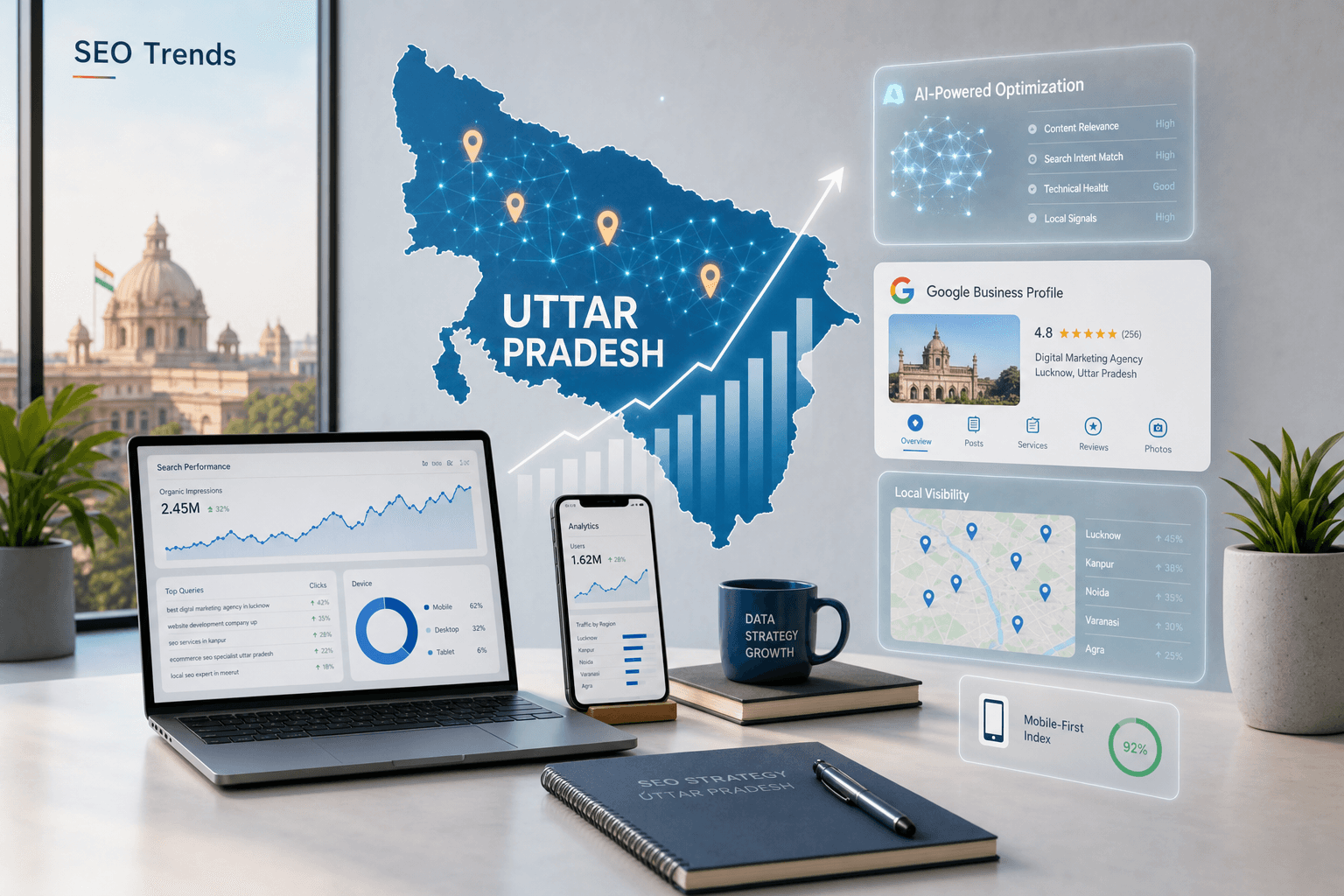
TL;DR: SEO in Uttar Pradesh in 2026 is driven by AI-generated answers (GEO), E-E-A-T trust signals, mobile-first behavior, and a fully optimized Google Business Profile. Lower competition lets businesses reach page one in 2 to 4 months, versus 12 to 18 months in Delhi or Mumbai.
For UP businesses, the real advantage is speed. The same fundamentals that take a year in Tier-1 metros can deliver first-page rankings in a few months when competition is lighter. Success comes down to adapting to four shifts: AI-generated answers, E-E-A-T, mobile-first indexing, and Google Business Profile optimization.
Written by the 365Digital team, SEO strategists and content marketers helping businesses grow organic and AI search visibility since 2013.
Why Businesses in Lucknow or Aligarh Rank Faster Than Those in Delhi
Search density in most UP cities is far lower than in Delhi or Mumbai. In Aligarh, a business that follows basic SEO (on-page targeting, a verified Google Business Profile, and consistent local citations) can appear on the first page within 2 to 4 months. In South Delhi, the same effort typically needs 12 to 18 months.
Google weighs relevance and authority against the pool of competitors in the same geographic area. Fewer optimized rivals mean the bar for "page-one worthy" drops. A Lucknow dentist who publishes service-specific pages, keeps an active GBP, and earns a handful of genuine reviews often outperforms most local competitors.
The takeaway is simple: UP businesses should not benchmark against Delhi-level timelines. Starting early captures a window that will shrink as more local firms adopt SEO.
How AI Search Is Changing SEO for Businesses in Noida and Kanpur
Traditional blue-link rankings no longer guarantee visibility. Generative Engine Optimization (GEO) structures content so AI systems (Google's AI Overviews, ChatGPT, and other models) select it for answer boxes. Without GEO, a top-ranked page may get zero clicks from AI-generated results.
The most common GEO gap is missing structured data. Add Schema.org LocalBusiness, FAQ, and Product markup to homepages and service pages, and make sure the opening paragraph answers the target query concisely. This step lets AI cite your content even when you rank below a competitor in organic search.
GEO is a separate discipline from conventional SEO. A page can rank well on backlinks and keywords yet stay invisible to AI answers if it lacks schema or clear, extractable answers. GEO requires a different optimization approach than conventional SEO, and treating it that way captures AI-driven traffic early.
What E-E-A-T Actually Requires From a UP Company in 2026
E-E-A-T (Experience, Expertise, Authoritativeness, Trustworthiness) now demands verifiable signals both on-site and off-site. Every blog post and service page should list a named author with real credentials. A dentist in Lucknow, for example, should show name, qualification, and years of practice on each article.
Publish business credentials such as GST registration, trade license, and a physical address with photos on a dedicated page. Keep NAP (name, address, phone) consistent across all local citations, because mismatched formats trigger trust concerns.
Off-site, genuine reviews with specific feedback and owner responses strengthen trust. Building content that demonstrates real expertise and experience creates the signals Google's quality raters look for.
Do Voice Search and Mobile-First Matter for a Business in Agra?
India's internet usage is 97% mobile-only, and penetration is projected to hit 70% by the end of 2025. A slow-loading site, or one that displays poorly on a small screen, will be invisible to most Agra customers searching for hotels, marble inlay shops, or dental clinics.
Voice queries are conversational ("best dentist near Taj Mahal"). Content with natural-language headings and direct answers matches how people speak to their phones, improving the odds of appearing in voice results and AI Overviews.
How to Improve Google Business Profile Rankings in a UP City
Three controllable levers drive GBP rankings: precise category selection, steady review velocity with substantive responses, and city-specific keywords in the description and posts.
Pick the most specific primary category (for example, "Dentist" instead of "Doctor") and add relevant secondary categories. Consistent reviews and detailed replies signal activity and trust to Google.
Use explicit city names in the GBP description ("industrial equipment supplier in Meerut") rather than generic "near me" phrasing. Add geo-tagged photos, fill the Q&A section with real questions, and post weekly updates to signal freshness.
The Technical and Content Standards That Separate Page-One UP Businesses
Even with low competition, a site has to meet Google's technical standards. Core Web Vitals (Largest Contentful Paint, Interaction to Next Paint, and Cumulative Layout Shift) must pass on mobile. Use PageSpeed Insights to spot unoptimized images, render-blocking JavaScript, and missing server-side caching, then fix them without a full rebuild.
Content must show topical authority. Instead of a single "Services" page, build a pillar page on a broad topic with supporting pages for each sub-service, all interlinked. A Noida manufacturer could build a pillar on "Industrial Fabrication in Noida" with child pages on CNC machining, sheet metal work, and custom fabrication.
Technical SEO and content strategy work together: solid site performance fuels the authority signals from well-structured content clusters.
Key Takeaways
- Lower competition lets UP businesses reach page one in 2 to 4 months, versus 12 to 18 months in Delhi or Mumbai.
- 97% of Indian users are mobile-only, so mobile-first performance is non-negotiable.
- AI-generated answers (GEO) require structured data and concise, factual content.
- Local SEO fundamentals (GBP, citations, reviews) remain the highest-leverage moves.
Frequently Asked Questions
What are the most important SEO trends for small businesses in Uttar Pradesh?
AI-generated search results (GEO), E-E-A-T trust standards, mobile-first optimization, and Google Business Profile management directly affect rankings. Executing these four areas lets UP firms reach page one faster than counterparts in Delhi or Mumbai.
How can local businesses in Lucknow use AI for SEO?
Implement Schema.org markup to make content readable to AI answer engines, use AI tools for content briefs and competitor gap analysis, and target conversational keywords that match voice-search patterns.
Is voice search important for businesses in Agra?
Yes. With 97% of users on mobile, voice queries are common. Structuring content with question-based headings ("What are the best marble inlay shops in Agra?") improves visibility in voice results and AI Overviews.
How long does it take to rank on Google in Uttar Pradesh?
In cities like Aligarh, Meerut, and Lucknow, basic SEO done correctly can reach page one in 2 to 4 months. The same effort in a saturated market such as South Delhi typically requires 12 to 18 months.
What SEO strategies work best for businesses in Noida in 2026?
Noida firms benefit most from GEO with proper Schema markup, a fully optimized Google Business Profile, and content clusters that establish topical authority. Technical SEO fundamentals and E-E-A-T signals are essential to stand out in this more competitive UP market.
Want help applying these SEO trends to your business in Uttar Pradesh? Talk to the 365Digital team.
Written by the 365Digital team, SEO strategists and content marketers helping businesses grow organic and AI search visibility since 2013.