
Content Formats That AI Cites Most Frequently
AI engines cite listicles for 35.6% of queries and product pages for 46-70% of commercial intent. Traditional blogs capture only 3-6% without optimization.
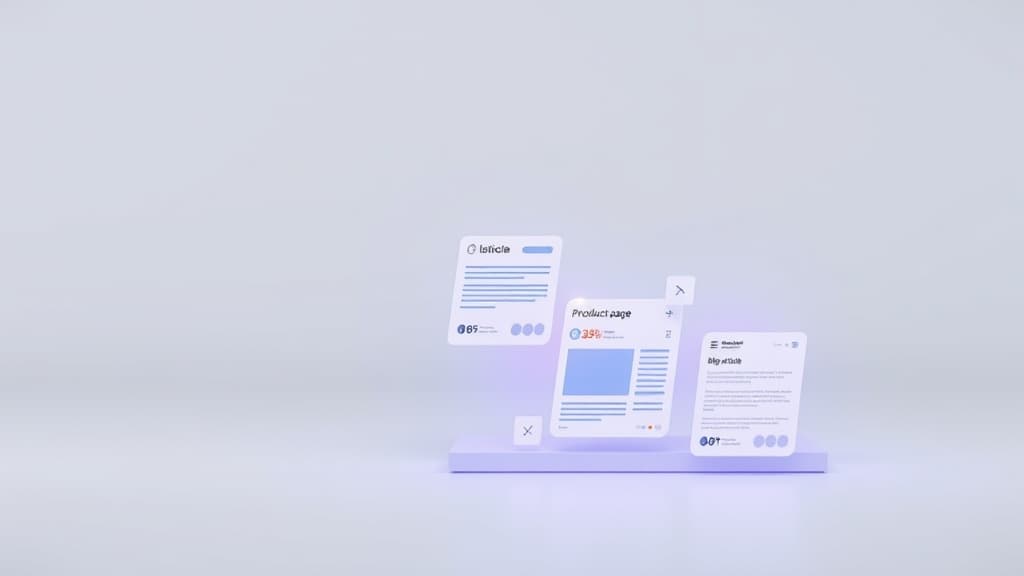
TL;DR: AI engines cite listicles for broad informational queries (35.6% of citations) and product-focused pages for commercial queries (46-70%). Front-loaded answers, scannable structure, and schema markup make these formats easy to extract, while traditional blog posts capture only 3-6% of AI citations.
AI search engines cite listicles most frequently overall, accounting for 35.6% of all AI citations, while product-focused content (reviews, comparisons, roundups) dominates commercial queries at 46-70%. Both win because they are structurally extractable: front-loaded, scannable, and answer-first. Traditional blog posts without this structure capture only 3-6% of AI citations.
Top-cited content formats across AI search platforms
Analysis of citations from ChatGPT, Perplexity, Google AI Overviews, and Gemini shows four formats leading the pack. Numbered and bulleted listicles hold 35.6% of all citations. Product-focused content, meaning dedicated product pages, professional reviews, comparison matrices, and recommendation roundups, covers 46-70% of citations for commercial intent. FAQ pages marked up with FAQPage schema also appear frequently. Long-form narrative blog posts, by contrast, fall to 3-6% of citations.
Why listicles attract AI citations
Listicles align with how large language models chunk text. Each numbered item forms a self-contained fact that maps to ItemList schema, letting the model lift a single point without parsing the surrounding prose. Business Insider's "10 best project-management tools," for example, lets an AI quote "Tool X: best for remote teams with built-in time tracking" verbatim. That reduces retrieval friction and boosts citation likelihood.
What product content wins for commercial queries
Product pages, professional reviews, comparison matrices, and roundups all fall under the product-content umbrella, but comparison matrices and roundups generate the strongest citation rates. They combine a list-like layout with product-specific entities (brands, features, prices) that match buying-intent queries. A comparison table showing "Battery life: 12 hours" can be cited directly, whereas a generic listicle may lack the granularity needed for a query like "MacBook Air vs Dell XPS battery life."
Across 365Digital client accounts, e-commerce brands consistently earn AI citations through well-structured comparison pages, while SaaS clients see higher visibility from listicles and FAQ-driven content. The pattern confirms that commercial intent favors product-focused, data-rich pages.
Reconciling divergent studies on format performance
One dataset of 768,000+ AI citations found product content leading for commercial queries; a larger study of hundreds of millions of citations identified listicles as the most cited format overall at 35.6%. The studies differ in scope. One isolates commercial intent, the other measures overall citations, so the findings complement rather than contradict each other. Listicles excel for broad informational queries; product content excels where intent is transactional.
Our recommendation: match the content format to the target query intent. Use listicles for "best X" informational searches, and structured comparison pages for "X vs Y" commercial searches. This dual-track approach is a core part of our AI search visibility services.
Structural traits that make content citable
Research shows 44.2% of AI citations come from the first 30% of a page's content. Front-load the answer in the opening paragraph and make each sentence a self-contained fact. Statistics act as citation magnets; adding a precise figure can boost AI visibility by up to 40%.
A clear heading hierarchy (H2, H3) and bullet points help chunking systems partition content. Use schema markup to signal that structure to AI parsers.
Format-specific optimization tactics
AI engines consistently cite seven core structures. Here is one actionable tactic for each.
- Direct-answer Q&A: Place a concise two-sentence answer at the top of the page, using the exact question as an H2. Pair it with QAPage schema for structural clarity.
- FAQ pages: Mark up each question with FAQPage schema. Begin each answer with a direct statement and skip the introductory filler.
- Numbered lists: Apply ItemList schema to every ordered list. Make sure each item holds a standalone fact that answers a sub-question.
- Comparison tables: Build HTML tables with clear headers and rows. Add Product, Offer, or AggregateRating schema so each cell can be cited on its own.
- Statistics-backed claims: Embed at least one precise figure per section and cite an authoritative source.
- Definition and glossary entries: Use H3 headings for terms and give concise definitions. Apply DefinedTerm schema for "What is X?" queries.
- Step-by-step how-tos: Number each step and keep descriptions short and self-contained.
Can traditional blog posts earn AI citations?
Traditional narrative blog posts capture only 3-6% of AI citations because they lack extractable structure. A blog can be transformed by adopting the traits above: open with a direct answer, insert a numbered list of key points, and embed statistics throughout. When a blog mimics an FAQ or listicle internally, AI engines treat it much like a dedicated format.
Key Takeaways
- Listicles account for 35.6% of AI citations; product content accounts for 46-70% of commercial citations.
- 44.2% of AI citations are drawn from the first 30% of a page.
- Adding precise statistics can increase AI citation likelihood by up to 40%.
- Traditional blog posts without structural optimization capture only 3-6% of AI citations.
Frequently Asked Questions
1. What is AI visibility (GEO) and how does it differ from SEO?
AI visibility, or Generative Engine Optimization (GEO), optimizes content so AI-driven platforms cite it as a source. Traditional SEO targets organic rankings in search engines, focusing on backlinks and keyword placement. GEO prioritizes answer-first formatting, schema markup, and self-contained facts to meet the extraction needs of large language models.
2. Does word count matter for AI citations?
Word count matters less than placement and structure. Most citations come from the first third of a page, so front-loading key facts outweighs total length. A well-structured 500-word FAQ can outperform a 2,000-word essay that buries the answer.
3. How do citation patterns differ between ChatGPT, Perplexity, and Google AI Overviews?
All four major platforms favor the same extractable formats: listicles, FAQ pages, comparison tables, and product comparisons. No public data shows a platform dramatically preferring a different format; variations stem from query context rather than format bias.
4. How can I improve citations in Google's AI Overviews?
Rank well organically and use structured data such as FAQPage, HowTo, and ItemList schema. Write concise, direct answers at the top of the page, back claims with statistics, and demonstrate E-E-A-T through clear authorship and reputable sources.
5. Should I focus on listicles or product content?
Both formats have merit. Listicles dominate informational queries, while product content leads for commercial intent. Choose the format that matches the user's search intent.
6. What does it mean if my brand receives zero AI citations?
About 26% of brands are not cited by AI engines, which usually signals a lack of extractable, structured content. Implementing GEO tactics such as front-loading answers, adding schema, and embedding statistics can move your brand into the 74% that do receive citations.
Want help making your content citable by AI, not just Google? Talk to the 365Digital team.
Written by the 365Digital team, a group of SEO strategists, automation specialists, and content marketers helping businesses grow their organic and AI search visibility since 2013.