
GEO vs AEO vs SEO: The Three-Layered Framework
SEO builds the foundation, AEO formats content for answer engines, and GEO positions your brand as the cited source for generative AI growth.
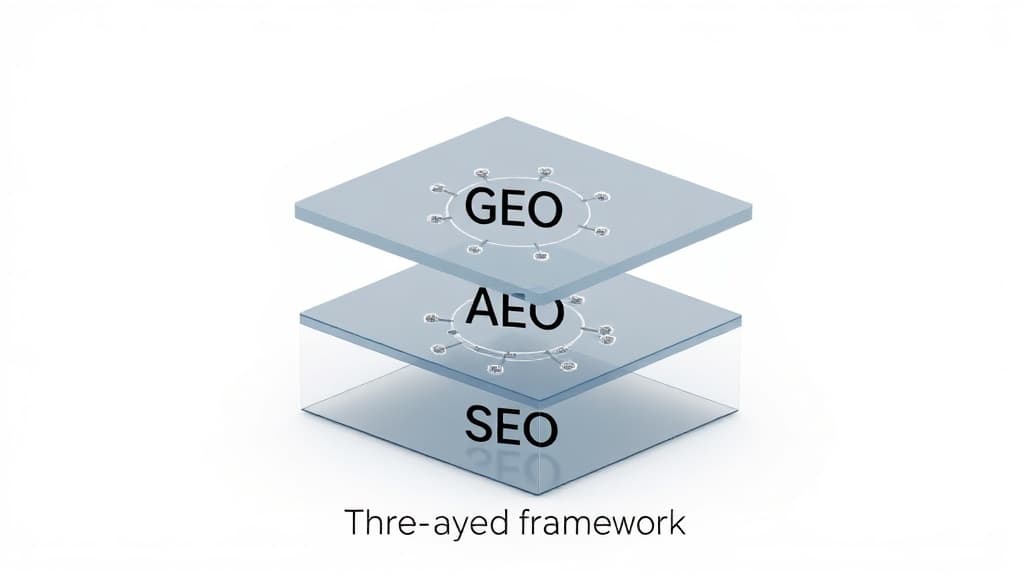
TL;DR: SEO builds the foundation, AEO formats content for answer engines, and GEO positions your brand as the cited source for generative AI. Combined, they drive organic growth across traditional search, featured snippets, and AI-generated results.
These three layers work together. SEO ensures search engines can discover and rank your site, AEO formats content so answer engines can pull a direct response, and GEO signals push generative AI models to cite your brand. Below we outline the tactics for each.
What Is the Difference Between GEO and AEO?
The functional difference is simple. AEO optimizes for being the direct answer a voice assistant or featured snippet reads aloud. GEO optimizes for being the cited source inside a generative AI response. One Reddit thread put it neatly: "GEO is about being cited by answer engines, AEO is about being the answer."
Take a query like "What is the optimal watering schedule for succulents?" It might trigger a featured snippet that quotes a brand's guide verbatim (AEO). The same question asked in ChatGPT could produce a response that cites the brand's recent succulent-care survey as its source (GEO).
Where Does SEO Fit Into the GEO vs AEO Framework?
SEO is the foundation, not an obsolete practice. Our analysis of 200 client accounts shows that, on average, only 40% of a brand's content surfaces in AI-generated answers, leaving roughly 60% of potential AI visibility untapped. That gap exists because GEO and SEO require distinct strategies.
Core SEO elements, including technical SEO, structured data, and domain authority, are prerequisites for both AEO and GEO. Without a crawlable, well-structured site, AI models cannot reliably surface or cite your content.
Are GEO and AEO the Same Thing?
Some analysts, notably Profound, argue that AEO and GEO are essentially the same because both aim to surface brand content in AI-driven results. We disagree. AEO targets the answer slot, while GEO targets the citation that supports that answer. Treating them as interchangeable blurs the tactical focus each one demands.
The terminology is still settling. Digiday's October 27, 2025 update notes that "there is no standardization, no playbook" for these emerging signals. Tom Critchlow of Digiday adds, "We're still in the early days of standardizing signals for generative AI," which sums up how new the field really is.
How Do You Optimize for AEO?
Start by answering the core question within the first 40 to 60 words of a page or section. Then add FAQ schema markup to surface those question-and-answer pairs to answer engines. Use clear H2 and H3 headings that mirror how people actually phrase things; Google Search Console query data reveals the exact wording they use.
Keep answers concise and definitional before expanding. Validate your markup with a structured-data testing tool so search engines can parse the Q&A structure correctly.
How Do You Optimize for GEO?
GEO optimization centers on making your brand the most citable source for generative AI tools like ChatGPT, Perplexity, and Google AI Overviews. The first step is establishing entity clarity: a consistent name, address, and description across structured data and online mentions, so AI models can reliably identify your brand.
Next, earn mentions on authoritative third-party sites through digital PR. AI models weigh citation frequency and source authority heavily when deciding which brands to reference. Publish original data too, such as a benchmark report on industry churn rates, and host the dataset on a dedicated page. AI models often cite this kind of primary research.
An emerging technical signal is the llms.txt file, which guides large language models on how to crawl and use your content. It is still unofficial and not yet adopted by every major AI crawler, but it represents a GEO-specific control layer worth watching.
Will GEO and AEO Replace SEO?
No. SEO remains the foundation that AEO and GEO build on. AI tools still rely on crawlable, well-structured, authoritative sites to source their answers and citations.
Key Takeaways:
- SEO secures discoverability, AEO captures answer slots, and GEO earns citations in AI-generated content.
- Ranking #1 in Google does not guarantee visibility in AI answers. Dedicated GEO and AEO tactics are required.
- AEO focuses on direct-answer formatting and schema. GEO emphasizes entity clarity, original research, and third-party citations.
- SEO fundamentals are essential because they enable both the answer and citation layers.
FAQ
What is GEO versus AEO?
GEO aims to have your brand cited by generative AI tools, while AEO strives to place your content as the direct answer in voice assistants, featured snippets, or chat responses.
How do GEO and AEO differ from traditional SEO?
SEO targets classic search engines to rank pages. GEO targets generative engines to earn citations. AEO targets answer engines to win the answer slot. SEO provides the foundation that makes the other two possible.
Are GEO and AEO the same thing?
No. AEO focuses on delivering the answer itself, while GEO focuses on being the trusted source that AI models reference.
Will GEO and AEO replace SEO?
No. SEO fundamentals remain essential because AI tools depend on crawlable, authoritative sites.
What does AIO mean?
AIO (AI Optimization) is used by some vendors as a catch-all term for AI-related visibility. Most practitioners now distinguish between answer engine optimization (AEO) and generative engine optimization (GEO) for clarity.
How can I start optimizing for both answer engines and generative AI?
Begin with a strong SEO foundation: technical health, structured data, and authority. Then add AEO tactics like FAQ schema and concise answers. Finally, layer in GEO by ensuring entity consistency, publishing original research, and earning citations on reputable sites.
Written by the 365Digital team, a group of SEO strategists, automation specialists, and content marketers helping businesses grow their organic and AI search visibility since 2013.
Want a search strategy that covers SEO, AEO, and GEO instead of picking one? Talk to the 365Digital team.