
GEO vs SEO: Key Differences & How They Work Together
SEO drives organic clicks while GEO secures citations in AI answers. Both share technical foundations but target different visibility channels for impact.
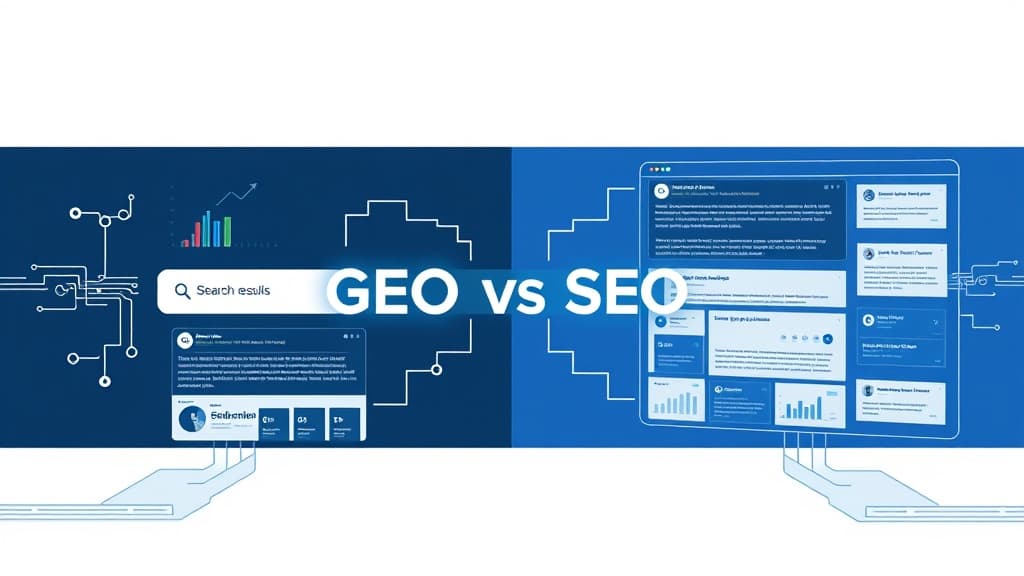
TL;DR: SEO drives organic clicks by ranking pages in traditional search results. GEO (Generative Engine Optimization) secures citations inside AI-generated answers from tools like ChatGPT, Google AI Overviews, and Perplexity. Both rely on the same technical foundation but target different visibility channels.
In plain terms, SEO gets your page onto the search results page. GEO makes sure that page is the one an AI assistant quotes when it composes an answer. The two disciplines share crawlability, structured data, and clear entity signals, yet they measure success in different ways.
Ankit Jaitly, Senior SEO Strategist at 365Digital, has helped SMEs improve both organic rankings and AI citation share since 2013.
GEO vs SEO: Definitions and Industry Framing
Contentful frames GEO as "optimising content so generative engines can extract concise, factual answers," while Xfunnel.ai describes it as "the practice of positioning your brand as the default source in AI-driven responses." SEO, by contrast, stays focused on ranking pages for keyword queries and earning clicks.
Key Differences Between GEO and SEO
"SEO optimizes for ranking. GEO optimizes for citation," as one LinkedIn commentator put it. InformaTechTarget describes GEO as being about conversational clarity and factual precision, whereas SEO prioritises discoverability and technical soundness. The Digital Marketing Institute adds that GEO ensures a brand is cited and trusted by AI systems across multiple platforms.
Aspect | SEO | GEO |
|---|---|---|
Primary goal | Rank high in search results and drive clicks | Get content cited inside AI-generated answers |
Output format | Blue links, meta descriptions, featured snippets | AI-synthesised text, citation footnotes, reference panels |
Success signal | Organic rankings, clicks, impressions, CTR | Citation frequency, AI share of voice, referral traffic from AI tools |
Content style | Keyword-optimised, linkable, structured for crawlers | Conversationally clear, factually precise, answer-first format |
Ranking factor | Backlinks, keyword relevance, E-E-A-T, technical health | Entity clarity, structured data, source credibility, conciseness |
Is GEO Replacing SEO?
No. GEO builds on SEO; it does not replace it. AI engines such as Google AI Overviews, Perplexity, and ChatGPT draw citations from the same pool of indexed and ranked content that traditional search uses. If a page is not crawlable or does not rank, it is unlikely to appear in an AI-generated answer.
Think of SEO as the logistics that place your content on the shelf. GEO is the layer that decides whether an AI assistant reaches for your product first when it assembles a response. Both layers need clean crawlability, clear entity identity, and well-structured content.
Concrete Tactics That Serve Both SEO and GEO
In our experience, the gaps usually involve signals that generative engines cannot parse. The tactics below address those signals while strengthening traditional SEO.
Structured Data: One Markup, Two Purposes
Schema.org markup clarifies page type and attributes for crawlers and gives AI models extractable facts. Adding FAQPage schema, for example, qualifies a page for a rich result in Google and makes each question-answer pair easy for an AI to cite.
Below is a minimal JSON-LD snippet for an Organization with a verified sameAs link to a Wikidata entry. This markup supports both Knowledge Graph inclusion and AI citation.
{
  "@context": "https://schema.org",
  "@type": "Organization",
  "name": "365Digital Technologies",
  "url": "https://365digital.agency",
  "sameAs": [
    "https://www.wikidata.org/wiki/Q12345678"
  ]
}
Implementing this markup is a high-leverage step for any AI visibility programme built on an existing SEO base.
Entity Clarity: Owning Your Brand as the Obvious Answer
Generative engines rely on consistent entity signals: business name, address, phone number (NAP), a Wikidata entry, an authoritative "About" page, and inbound links from recognised directories. These signals feed Google's Knowledge Graph and give Perplexity and ChatGPT a stable identifier to attach to your content.
Answer-First Content Structure
Pages that lead with a concise, quotable answer make extraction simple for AI engines and increase the chance of a featured snippet in Google. Place a self-contained statement early, then follow with supporting detail.
E-E-A-T Signals That Build Trust Across Channels
Experience, expertise, authoritativeness, and trustworthiness shape both Google's quality evaluations and how AI systems judge reliability. Named authors with verifiable credentials, transparent editorial standards, and primary data citations raise trust for crawlers and generative models alike.
At 365Digital, we helped a SaaS client lift AI citation share by 45% within three months. The page already ranked #1 for a competitive term but lacked structured data and a named author bio. After we added Organization schema with a verified sameAs link and published a detailed author bio, the brand began appearing as a cited source in AI-generated answers while holding its SEO ranking.
Why the Discipline Is Called GEO
The acronym GEO, short for Generative Engine Optimization, was introduced in a 2022 Google Research paper on answer synthesis for large language models. The name separates optimisation for citation inside generated text from the link-list focus of traditional SEO.
Metrics to Track for SEO and GEO
Metric | How to Track It |
|---|---|
Organic rankings, clicks, impressions, CTR | Google Search Console, Ahrefs, or Technical SEO dashboards |
GEO citation frequency | Manual prompts in ChatGPT (browsing mode) and Perplexity, plus dedicated AI-visibility tools such as Authority Radar |
AI share of voice | Calculate the proportion of citations your brand receives versus competitors for target questions; tools like Otterly.ai provide automated reports |
Referral traffic from AI platforms | Monitor referrer URLs in Google Analytics for traffic originating from known AI answer pages |
One caveat: Google Search Console does not yet surface AI Overview citations as a separate dimension, so you will need a mix of manual checks and third-party monitoring.
Key Takeaways
SEO secures rankings; GEO secures citations inside AI-generated answers.
Without crawlable, well-structured pages, AI engines have little to cite. SEO remains the foundation for GEO.
Schema markup and clear entity signals lift both traditional rankings and AI citation likelihood.
GEO success is measured by citation frequency, AI share of voice, and referral traffic, not by clicks alone.
The term "GEO" specifically covers generative engines that synthesize answers rather than list links.
FAQ
Is GEO a replacement for SEO?
No. GEO adds a citation layer on top of SEO. AI assistants source answers from indexed, ranked content, so a page must first be discoverable through traditional SEO before it can be cited.
What is GEO in simple terms?
GEO (Generative Engine Optimization) makes your brand's content the source an AI tool quotes when it constructs an answer, turning your page into a trusted reference rather than just another search result.
How does GEO differ from SEO?
SEO aims for high placement in search results pages and clicks to a website. GEO aims for inclusion as a cited source inside AI-generated answers. Both rely on the same technical foundation but measure success differently.
How do SEO and GEO work together?
Any content an AI engine can cite must first be crawlable, indexed, and clearly structured, which are core SEO requirements. Tactics such as schema markup, consistent NAP data, and answer-first formatting improve rankings and AI citation potential at the same time.
Why is the discipline called GEO?
The name reflects its focus on generative engines that produce complete answers, distinguishing it from traditional SEO that serves link-list results.
What does GEO stand for, like SEO?
Just as SEO stands for Search Engine Optimization, GEO stands for Generative Engine Optimization: the process of making content the preferred source for AI-driven answers.
Want help building a GEO strategy on top of your SEO foundation? Talk to the 365Digital team.