
How to Build a GEO Strategy from Scratch
A GEO strategy runs in five phases: audit AI mentions, prioritize gaps, restructure content around entities, add schema, and monitor citations monthly.
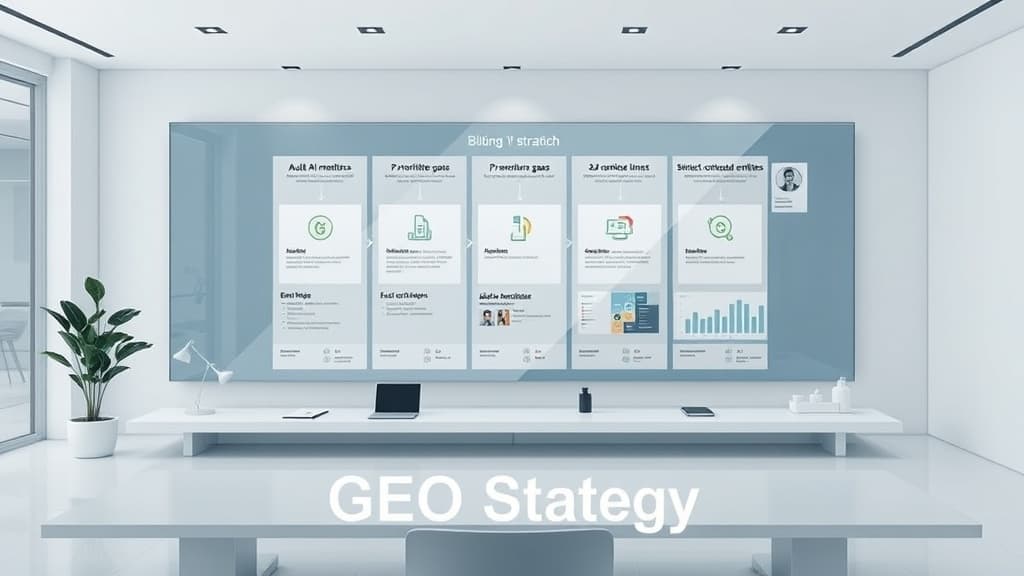
TL;DR: A GEO strategy runs in five phases: audit how AI engines mention your brand, prioritize the gaps that matter, restructure content around entities and direct answers, add schema and earn citations, then monitor your AI citations monthly. Use the template below to launch the process.
Building a GEO strategy starts with understanding how generative AI currently describes your brand, then reshaping your content so those engines can cite it accurately. Unlike traditional SEO, GEO measures success by citation frequency and accuracy, not keyword rankings.
What Is a GEO Strategy (And What It Isn't)?
Generative Engine Optimization (GEO) is the practice of optimizing content so it appears in AI-generated answers from ChatGPT, Google Gemini, Microsoft Copilot, and Perplexity. Searching "GEO strategy" also surfaces results about geopolitical "geostrategy," but the digital-marketing meaning is the one that matters for AI visibility.
In GEO, an entity is a distinct brand, product, or concept that AI models recognize and can reference. GEO does not chase keyword rankings. It aims for accurate, repeatable citations in AI answers.
How Is GEO Different From SEO?
SEO targets higher rankings in search results using keywords, backlinks, and technical tweaks. GEO targets inclusion in AI-generated answers by structuring content around entities, direct answers, and trusted citations. A brand can rank first in Google and still be missing from ChatGPT or Gemini responses if its content isn't AI-ready.
| Dimension | SEO | GEO |
|---|---|---|
| Primary goal | Rank pages in SERPs | Earn accurate citations in AI answers |
| Unit of optimization | Web page + keyword | Entity + direct answer + topic cluster |
| Key metric | Rankings, clicks, impressions | Citation frequency, share of voice, accuracy |
Our SEO services still drive organic traffic, but GEO adds a distinct layer that needs its own content and citation tactics.
The 5-Phase Framework for Building a GEO Strategy From Scratch
These five phases take you from zero AI visibility to a sustainable GEO program.
Phase 1: Audit
Query ChatGPT, Gemini, Perplexity, and Copilot with 20 to 50 core buyer questions. Record each engine's answer, the sources it cites, and any gaps where your brand is missing or misrepresented.
Phase 2: Prioritize
Score gaps by commercial intent rather than search volume. A question that drives a purchase decision and currently cites a competitor gets the highest priority.
Phase 3: Restructure
Rewrite priority pages to lead with a concise, quotable answer. Use entity-first language, a conversational tone, and clear H2/H3 question-answer pairs. Add FAQ blocks that mirror the exact questions users ask.
Phase 4: Build Authority Signals
Add FAQ, Article, and Organization schema to each page. Earn digital-PR mentions from trusted sites such as industry trade publications, Wikipedia, or G2, since these citations raise an AI model's confidence in your content. Validate all markup with Google's Rich Results Test before publishing.
Phase 5: Monitor and Iterate
Run the same audit queries every month. Track citation frequency, share of voice, and representation accuracy, then feed new gaps back into Phase 2 for continuous improvement.
Our AI Search Visibility (GEO) services run on this framework, but any team can use the template below.
What Should a GEO Plan Template Include?
- Core brand queries to test monthly: 20 to 50 real buyer questions, run across all four AI models.
- Current AI answer accuracy score: whether your brand is present, accurate, or absent, on a 3-point scale.
- Priority pages to restructure: 5 to 10 URLs most tied to revenue, each assigned a target entity and a direct-answer sentence.
- Schema types to add: FAQ for Q&A, Article for in-depth guides, Organization for brand authority.
- Citation targets: the digital-PR outlets and trusted domains (industry magazines, Wikipedia, and similar) you will pursue.
- KPI baseline: your current citation frequency, share of voice, and accuracy percentage.
- Monthly iteration log: new gaps, wording shifts, and content updates for the next cycle.
To put numbers on it: one mid-size SaaS client saw AI citation frequency climb from 0 to 12 mentions per month within six weeks after restructuring three product pages and earning two industry-journal backlinks.
What Content Actually Performs Well in AI Answers?
Content that gets cited by AI shares three traits:
- It treats keywords as entities and context, for example "CRM software for small-business sales" rather than stuffing in "best CRM for small business."
- It uses conversational, answer-first language that reads like a knowledgeable person responding directly to a question.
- It includes an FAQ block with exact user questions, each answered by a short, quotable sentence followed by supporting detail.
Which Tools Help You Execute a GEO Strategy?
These tools map to the four AI engines:
- Ahrefs Brand Radar monitors brand mentions across ChatGPT, Gemini, Perplexity, and Copilot.
- Semrush AI Toolkit tracks Google AI Overviews specifically.
- Peec AI and Otterly.AI focus on ChatGPT, Gemini, and Perplexity visibility.
- Profound provides share-of-voice metrics broken down by model.
Google Search Console now surfaces impressions from AI Overviews, a native signal for Google's AI engine. To automate monthly audits, we use n8n to schedule prompts against the APIs and log results.
How Do You Measure Whether Your GEO Strategy Is Working?
Focus on three core GEO KPIs:
- Citation frequency: total AI mentions for your priority queries.
- Share of voice: the proportion of citations you own versus competitors.
- Accuracy score: the percentage of mentions that represent your brand correctly.
Track referral traffic from AI tools where you can, but don't treat traditional SERP rankings or raw impression counts as GEO success indicators.
Key Takeaways
- GEO optimizes for AI-generated answers; SEO optimizes for ranked links.
- Start with an audit of real buyer questions across ChatGPT, Gemini, Perplexity, and Copilot.
- Use entity-first, answer-first content with structured FAQ schema.
- Measure success by citation frequency, share of voice, and accuracy, not by rankings.
- Tools like Ahrefs Brand Radar, Semrush AI Toolkit, and n8n handle tracking and automation.
Frequently Asked Questions
What is generative engine optimization?
Generative Engine Optimization (GEO) refines digital content so AI models such as ChatGPT, Google Gemini, or Microsoft Copilot can cite it accurately when answering user questions.
How is GEO different from SEO?
SEO aims to rank pages in search results using keywords and backlinks. GEO aims to become the source an AI selects for its answers, measuring citation frequency and accuracy instead of rankings.
How do I start a GEO strategy from scratch?
Begin with an audit of AI engine answers to real buyer questions, prioritize gaps by commercial intent, restructure pages around entities and direct answers, add schema markup, earn trusted citations, and monitor AI mentions monthly.
What kind of content works best for GEO?
Content that leads with a concise answer, uses conversational language, and includes FAQ blocks with exact user questions performs best in AI citations.
How do I measure GEO success?
Track citation frequency across AI models, share of voice for priority queries, and the accuracy of your brand representation. Don't rely on traditional SERP rankings.
What tools help with GEO?
Ahrefs Brand Radar, Semrush AI Toolkit, Peec AI, Otterly.AI, Profound, and n8n for automation cover tracking and workflow support.
Want help building a GEO strategy for your business? Talk to the 365Digital team.
Written by the 365Digital team, a group of SEO strategists, automation specialists, and content marketers helping businesses grow their organic and AI search visibility since 2013.